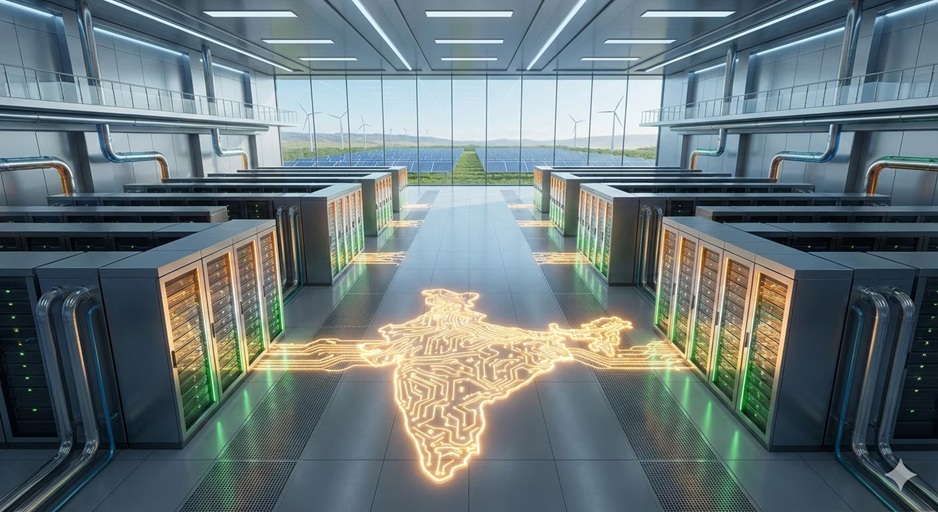
India is standing at a defining inflection point in its digital journey. What began as an outsourcing-led IT services economy has now evolved into a full-stack digital powerhouse—producing platforms, products, data, and increasingly, artificial intelligence at scale. At the heart of this transformation lies a critical but often underappreciated asset: data center infrastructure. As AI workloads grow more compute-intensive, data-hungry, and latency-sensitive, the role of modern data centers is shifting from being passive infrastructure to becoming strategic enablers of national competitiveness.
Over the last decade, India’s data consumption has grown exponentially, driven by affordable connectivity, a mobile-first population, cloud adoption, and the rise of digital public infrastructure. Today, AI is accelerating this trajectory even further. Training large models, running inference at scale, and supporting real-time applications demand far more than traditional enterprise IT setups. They require high-density compute environments, resilient power architectures, advanced cooling, and deterministic network performance—capabilities that only next-generation data centers can deliver.
This shift is also changing how enterprises think about infrastructure ownership. Rather than building everything in-house, organizations are increasingly opting for flexible, scalable environments that allow them to deploy workloads quickly without long gestation periods. This has led to the rise of specialized colocation data center providers who offer enterprises the ability to deploy mission-critical workloads while retaining control over hardware, compliance, and data governance. For AI-led businesses, this model provides the best of both worlds: cloud-like agility combined with infrastructure-level transparency and performance.
Another powerful tailwind for India’s data center growth is the policy and regulatory environment. Data localization norms, sector-specific compliance requirements, and sovereign data considerations are pushing enterprises to keep data within national boundaries. At the same time, government initiatives such as Digital India, IndiaAI Mission, and smart city programs are generating massive volumes of data that must be processed, stored, and secured domestically. This convergence of regulation and innovation is making infrastructure strategy a boardroom conversation rather than an IT afterthought.
Geography, too, plays a decisive role. India’s coastal cities have traditionally been hubs for connectivity due to submarine cable landings, enterprise concentration, and access to skilled talent. Among them, a data center in Mumbai continues to remain a strategic anchor because of its proximity to financial institutions, hyperscale cloud nodes, and international network gateways. However, the next phase of growth is clearly multi-city and distributed, with emerging hubs across southern, western, and northern India gaining prominence as enterprises look to balance latency, resilience, and regional demand.
Sustainability has emerged as another defining dimension of modern data centers. AI infrastructure is energy-intensive, and unchecked growth could strain power grids and carbon budgets. As a result, energy efficiency is no longer a “nice to have”—it is fundamental to scalability. Advanced cooling technologies, higher rack densities, liquid cooling for GPUs, and renewable energy sourcing are becoming integral to infrastructure design. Operators that can deliver lower power usage effectiveness (PUE) and predictable energy economics will be better positioned to support long-term AI growth.
From an enterprise perspective, data centers are also evolving into platforms for innovation. Beyond hosting compute and storage, they are becoming ecosystems where cloud services, AI platforms, cybersecurity, and managed services converge. This integrated approach allows businesses to move faster—from proof of concept to production—without being constrained by infrastructure bottlenecks. For startups and research institutions, access to such environments can be the difference between experimentation and execution.
Importantly, India’s data center story is no longer just about serving domestic demand. As global enterprises look to diversify supply chains and technology footprints, India is emerging as a credible destination for regional workloads. Competitive operating costs, a strong talent pool, improving infrastructure, and a large domestic market make India uniquely positioned to serve Asia, the Middle East, and Africa. In this context, data centers are becoming digital ports—facilitating the flow of data just as physical ports enable trade.
Looking ahead, the next decade will likely see data centers play a central role in shaping India’s economic and technological trajectory. As AI becomes embedded across sectors—from healthcare and finance to manufacturing and governance—the need for secure, scalable, and sovereign infrastructure will only intensify. The winners in this landscape will be those who view data centers not merely as real estate and power, but as strategic assets that underpin innovation, trust, and national capability.
India’s digital ambitions are bold, and rightly so. Realizing them will depend not just on software brilliance or algorithmic breakthroughs, but on the strength of the physical infrastructure that supports them. In that sense, data centers are no longer behind the scenes—they are at the very center of India’s AI-driven future.